GSAP for free: what the license allows and what it does not
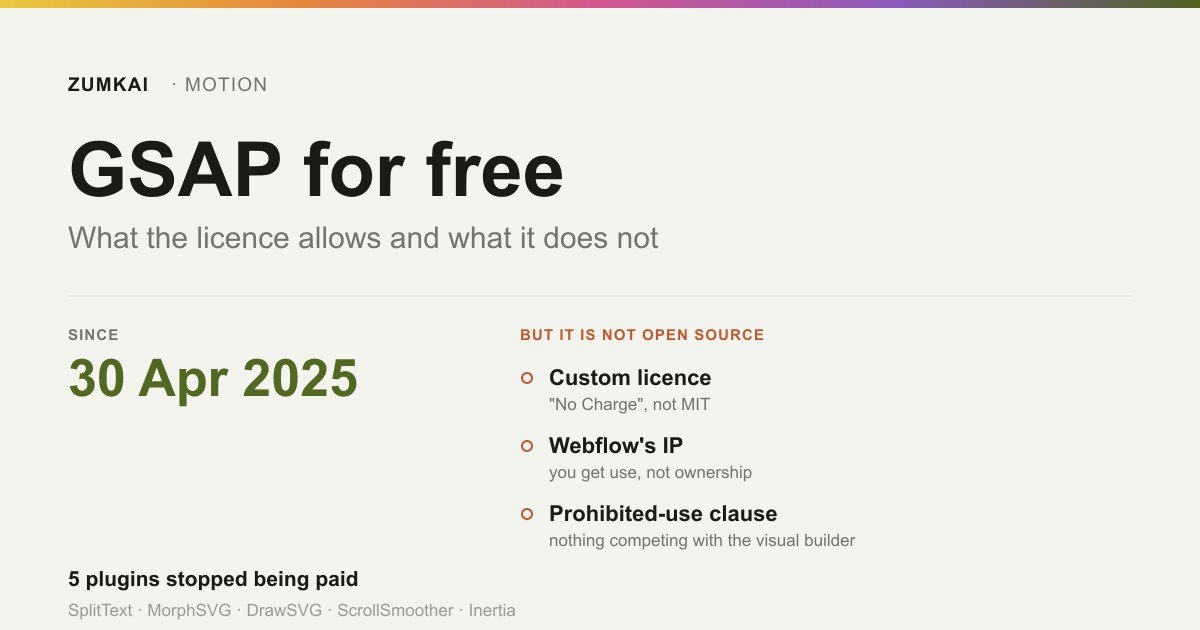
GSAP became free in April 2025, and it never became open source. The license is proprietary, Webflow holds the IP and a non-compete clause exists.
- gsap
- motion
Contents
Since 30 April 2025, GSAP is free for everyone, commercial use and every plugin that used to cost money included.
Free, though, means something other than open source. The license is proprietary, it goes by the name "No Charge", Webflow holds all the intellectual property, and a clause forbids one specific kind of use. None of the Portuguese texts I found on the subject mentions that.
This post covers what changed, what the license says in fact, and what became worth using.
What changed, and when
Two milestones, a year and a half apart.
October 2024: Webflow announces the acquisition of GreenSock, the company behind GSAP.
30 April 2025: the effective date of the new license, which makes the whole library free, the Club GreenSock plugins included. It is the date on the licensing page itself (GSAP, accessed 20 August 2026).
Today the site footer reads only "©2026 GSAP — A Webflow Product". Club GreenSock, the subscription program that gave access to the advanced plugins, stopped appearing on the pricing and license pages.
The five that were paid, and the ScrollTrigger myth
A correction belongs here, because the wrong information circulates a lot.
| Plugin | Before | What it does |
|---|---|---|
| SplitText | Paid | Splits text into lines, words and characters for animating |
| MorphSVG | Paid | Turns one SVG shape into another |
| DrawSVG | Paid | Animates an SVG stroke as though it were being drawn |
| ScrollSmoother | Paid | Smooth scroll; depends on ScrollTrigger |
| Inertia | Paid | Momentum and inertia on draggable elements |
| ScrollTrigger | Always free | Triggers and synchronizes animation with scroll |
| Flip | Always free | Animates a state change between two layouts |
| Observer | Always free | Detects scroll and entry events |
Several texts list ScrollTrigger among the plugins that "became free". It was never paid. Getting that wrong matters in practice: anyone who avoided ScrollTrigger thinking it cost money lost time reinventing scroll with IntersectionObserver for nothing.
And none of those ships in the core. GSAP's core has Tween, Timeline and the animation basics, and everything else is a plugin you import.
The motion patterns I reverse-engineered on agency sites use almost all of those plugins together.
It is no MIT: what the "No Charge" license says
This is the part the celebration posts skip.
GSAP migrated to no open source license. It adopted a proprietary license, with no charge, under terms worth reading before assuming total freedom.
Ownership stays with Webflow. The text is direct: "All intellectual property rights in GSAP Products... remain the exclusive property of Webflow." You receive a right to use, not ownership.
You cannot touch the branding. The license forbids you to "remove or alter any proprietary notices or branding from GSAP Products".
And one use falls outside the grant. It is the point that changes the risk assessment for anyone building a product.
The non-compete clause, in plain terms
The license forbids you to "use any GSAP Products for any Prohibited Uses without prior written consent". It defines Prohibited Uses as implementation in a tool that "encourages, induces, or materially assists in creating a solution that competes with Webflow's visual animation building capabilities."
Translating the real reach: the target is visual animation builders, not software development in general.
| You build | Affected? |
|---|---|
| A client site with GSAP animation | No |
| A SaaS product using GSAP in the interface | No |
| A portfolio, landing page, e-commerce | No |
| A tool with a visual animation editor for end users | Yes, probably |
| A no-code plugin generating animation through a graphical interface | Yes, probably |
For 99% of the people reading this, the clause is irrelevant. But if you build a tool in the no-code or visual editor space, it is the most important item on this page, and it demands written consent.
The clause itself is not what bothers me. Webflow paid for the library and can set the terms. The part that bothers me is that "GSAP is free now" became a headline with nobody reading the definition of free. A central dependency of your stack became the property of a company that competes in part of the market, and that is architecture information, not licensing gossip.
The FAQ clears AI-generated code, in so many words
The official FAQ answers the doubt before it becomes a rumor: "AI-generated code is not a 'Prohibited Use'", naming ChatGPT and Cursor.
That settles a legitimate concern. If the clause forbids a tool that "materially assists" in creating a competing solution, an agent writing GSAP for you could, under a twisted reading, fall under the definition. The documentation closes that door in the open.
In practice: generating GSAP animation with an agent is normal, permitted use.
The catalog of motion techniques for the web covers where each plugin enters the flow.
What became worth using
Three plugins that used to fall outside a small budget and now cost nothing.
SplitText changes the visual result most per line of code. Splitting a heading into characters or lines and animating them in sequence is the typographic signature of close to every premium site. Before, anyone not paying resorted to a hack with hand-written <span> elements or to worse libraries.
The cost of entry today is six lines:
import { gsap } from 'gsap'
import { SplitText } from 'gsap/SplitText'

gsap.registerPlugin(SplitText)

const split = new SplitText('.title', { type: 'lines' })
gsap.from(split.lines, { yPercent: 100, opacity: 0, stagger: 0.08 })
Two cautions that save rework: run the split after the font loads, or the line breaking gets computed with the fallback font and comes out wrong; and keep the instance so you can call split.revert() before recalculating on resize.
MorphSVG solves shape transformation that has no CSS equivalent. An icon that becomes another icon, an illustration that transforms on scroll, and no native technique does that with the same control.
DrawSVG animates an SVG stroke as though it were being drawn. Approximating it with stroke-dasharray in pure CSS works, and the sequence control and the chaining with the rest of the timeline stand no comparison.
ScrollSmoother is the only one on the list I would recommend caution about. It depends on ScrollTrigger and rewrites the scroll behavior of the whole page. Smooth scroll is the technique that draws the most accessibility complaints and gets in the way most on a long page. Free is no reason to turn it on.
The single-vendor risk
Ending with the judgment is worth doing, and it has nothing to do with the license.
The original team maintains GSAP today, working full time at Webflow. That is good: more resources, continuous development, no abandoned project. Version 3.15 came out in 2026, support stays active.
And it is also a concentration. The most used animation library on the web belongs to one company, with a proprietary license and a restricted use clause. A legal fork is uncertain at best, since the license grants use, not redistribution.
None of that is a reason to avoid GSAP, it is a reason to know where you are stepping. A technique CSS handles on its own at equivalent quality needs no dependency. CSS scroll-driven animations already cover reveal, simple parallax and a progress bar with no library at all.
The rule I use: GSAP for complex orchestration, CSS for what is simple and reversible. That way GSAP stays where it is irreplaceable, and the rest of the site depends on it in no way.
In practice, the split looks like this:
| Effect | Needs GSAP? |
|---|---|
| Reveal on entering the viewport | No, use animation-timeline: view() |
| Simple parallax | No, use animation-timeline: scroll() |
| Reading progress bar | No, pure CSS |
| Transition between layout states | No, View Transitions covers a good part |
| A timeline with several coordinated stages | Yes |
| Section pinning with scrub | Yes |
| SVG shape morph | Yes |
| Text split with precise stagger | Yes |
Half that table was mandatory GSAP two years ago. Today it is not, and that is the news nobody delivered alongside the one about GSAP becoming free.
Frequently asked questions
Can I use GSAP in a commercial client project without paying anything?
You can. The official FAQ answers: "Can I really use GSAP in commercial projects without paying anything? Yes, really!" It holds for every plugin, the Club ones included.
Did GSAP become open source?
No. It became free, under a proprietary license called "No Charge". Webflow keeps all the intellectual property, you cannot alter branding notices, and the license grants use rather than redistribution.
Do I need a special license if my product uses GSAP in its interface?
In all likelihood, no. The clause targets tools that build animation through a visual interface and compete with Webflow on that specific point. A product that only uses GSAP in its own interface falls outside it. If you build a visual animation editor, seek written consent.
Does Club GreenSock still exist?
The subscription program no longer appears on the pricing and licensing pages. Every plugin it offered is available at no cost.
Sources
- GSAP — Licensing. Effective date of the "No Charge" license: 30 April 2025. Accessed 20 August 2026.
- GSAP — Pricing. Accessed 20 August 2026.
- GSAP — Plugins. Accessed 20 August 2026.
- GSAP — Docs v3.15. Accessed 20 August 2026.
Verified on 20 August 2026.
Review trigger: revisit when (a) the "No Charge" license changes or gets replaced, (b) the definition of "Prohibited Uses" changes reach, (c) GSAP migrates to a recognized open source license, or (d) v4 arrives with a change to the distribution model.
Read next

Motion •
Motion Design for the Web: The Complete Guide
Scroll, text, images and video: the complete catalog of motion techniques for the web, with implementation in Next.js and the cases where each one pays off.
- motion
- scroll

The definitive guide — a Next.js site built around motion and scroll
The scroll foundation that, when missing, keeps the animations from working at all: Lenis, GSAP and Next.js wired in the right order and the mistakes to avoid.
- next.js
- lenis
Infra •
Documentation: deploying a Next.js application with GitHub + Hostinger
Every push becomes a live site with no hosting panel involved: connecting GitHub to Hostinger, the build settings that break and the checks after each deploy.
- deploy
- github